Take A Wild Yawn: Relax and Release

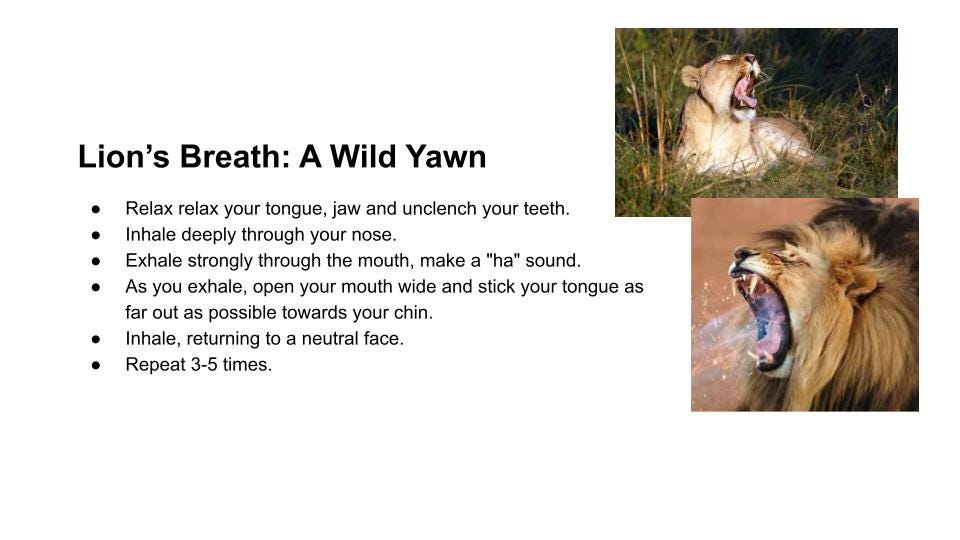
We unconsciously yawn and sigh throughout the day. While yawing is associated with sleep deprivation and drowsiness during the day it also seems to occur when people experience boredom. Yawning is a normal biological function controlling lung compliance, but it is also a social behavior in some parts of the world it is considered rude or disrespectful behavior in the presence of others.
Yawns release air build up in your lungs, boost brain blow flow and is a primal wake up signal of arousal. Lions and other animals also yawn. A psychophyisological reflex yawning is integrated behavior involving with voluntary and autonomic neurological pathways.
About yawning:
transition between wakefulness and sleep or vice versa
response to fatigue, tiredness, stress, overwork, lack of stimulation, hunger or satiety
associated with sleep deprivation during the night and drowsiness during the day and often occurs when people are boredom.
As a voluntary reflex yawning is contagious signalling social disconnection. Why not just have a good yawn when you are away from others and preferably outdoors.
Guggisberg AG, Mathis J, Schnider A, Hess CW. Why do we yawn?. Neurosci Biobehav Rev. 2010;34(8):1267-1276. doi:10.1016/j.neubiorev.2010.03.008
Sankar J, et al. (2017). Asthma — a disease of how we breathe: Role of breathing exercises and pranayam. link.springer.com/article/10.1007%2Fs12098-017-2519-6
Severs LJ, Vlemincx E, Ramirez JM. The psychophysiology of the sigh: I: The sigh from the physiological perspective. Biol Psychol. 2022;170:108313. doi:10.1016/j.biopsycho.2022.108313